CHAPTER 5: BUSINESS CAPITAL AND PROFITS
5.1 MEANING AND TYPES OF CAPITAL
Meaning of Capital
Capital refers to the total amount of money or wealth employed to run a business. It represents any form of wealth set aside for the production of further wealth.
There are two major views on the meaning of capital:
Accountant’s point of view
Economist’s point of view
https://dtwedustore.com/shop/commerce-key-points-by-dtw-tutorials-e-book-42-pages
Accountant’s Definition of Capital
Capital is defined as the total assets of a business minus its liabilities to external parties. It is also regarded as the original money used to start a business.
CAPITAL = TOTAL ASSETS − TOTAL LIABILITIES
Economist’s Definition of Capital
To an economist, capital is wealth reserved or used for producing more wealth. It includes man-made tools and equipment used in the production of goods and services.
Layman’s Concept of Capital
To the layman, capital simply means the total amount of money required to run a business.
https://dtwedustore.com/shop/commerce-key-points-by-dtw-tutorials-e-book-42-pages
5.2 TYPES OF CAPITAL
The various types of business capital include:
Authorized / Registered / Nominal Capital
This is the maximum amount of capital stated in the Memorandum of Association which a company is allowed to issue to the public.
Issued Capital
This is the portion of the authorized capital that the company offers to the public for subscription.
Called-up Capital
This is the part of the issued capital that shareholders have been requested to pay.
Capital Employed
This is the total capital used to finance the business operations.
CAPITAL EMPLOYED=TOTAL ASSETS−CURRENT LIABILITIES
Liquid Capital
These are assets that can easily be converted into cash at short notice, such as cash, debtors, and inventories.
Circulating or Floating Capital (Working Capital)
This is the capital used for day-to-day business operations, such as payment of wages, salaries, and purchase of raw materials.
WORKING CAPITAL=CURRENT ASSETS−CURRENT LIABILITIES
Uncalled Capital
This is the portion of issued capital that has not yet been called up for payment by the company.
Capital Owned
This represents the owner’s financial interest or net worth in the business.
CAPITAL OWNED=TOTAL ASSETS−ALL LIABILITIES
Fixed Capital (Fixed Assets)
These are long-term assets used in the business, such as buildings, plants, machinery, and motor vehicles.
Loan Capital
This is money borrowed from external sources, such as debentures, bank loans, and mortgage loans.
https://dtwedustore.com/shop/commerce-key-points-by-dtw-tutorials-e-book-42-pages
IMPORTANCE OF WORKING CAPITAL
It prevents tying down too much money in current assets.
It helps to determine whether a business is solvent.
It shows the amount of funds available for daily business operations.
It indicates whether the business is being financed internally.
It serves as a measure of the financial health of a business.
It aids business planning and helps to avoid losses.
It provides a basis for profit-making through stock purchase.
https://dtwedustore.com/shop/commerce-key-points-by-dtw-tutorials-e-book-42-pages
5.2 CALCULATION OF WORKING CAPITAL
DLHS Enterprises
Financial Position as at 31st December, 2013 is as follows:
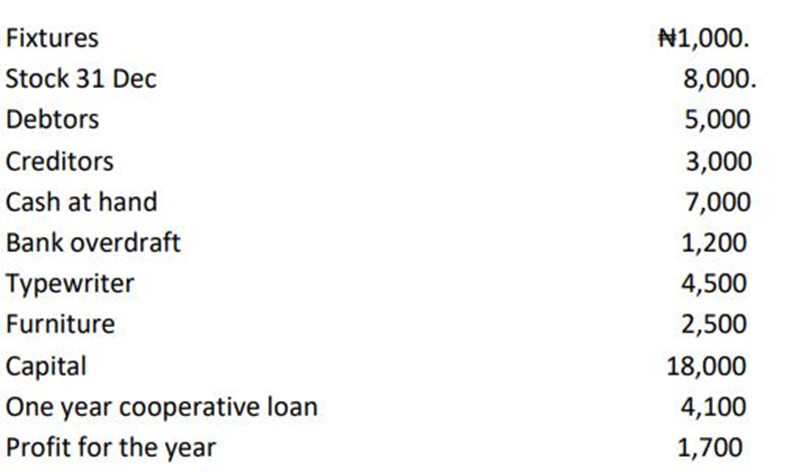
Question
Calculate the following:
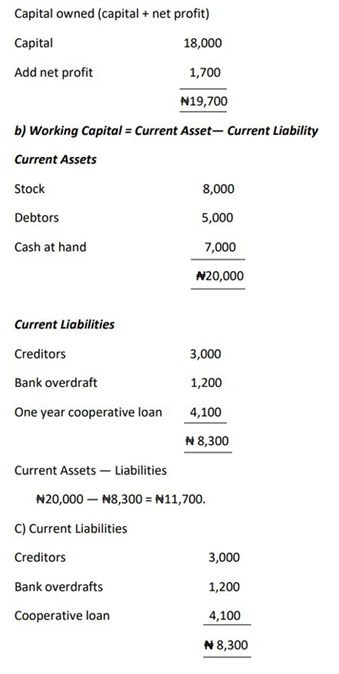
a. Capital owned
b. Working capital
c. Current liabilities
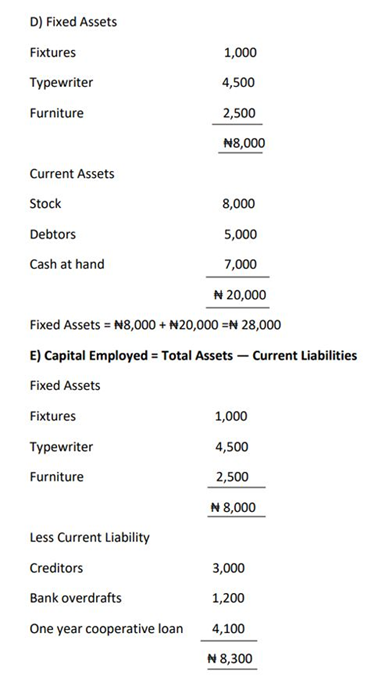
d. Fixed capital
e. Capital employed
SOLUTIONS
https://dtwedustore.com/shop/commerce-key-points-by-dtw-tutorials-e-book-42-pages
5.3 PROFIT – MEANING, TYPES AND CALCULATION OF PROFITS
Meaning of Profit
Profit refers to the financial gain or benefit accruing to a business owner from business activities. The main objective of every business organization is to make profit. It represents the reward for investing capital and taking business risks.
https://dtwedustore.com/shop/commerce-key-points-by-dtw-tutorials-e-book-42-pages
Accountant’s View of Profit
To an accountant, profit is the excess of income over expenditure. Accountants classify profit into:
Gross profit
Net profit
Economist’s View of Profit
An economist sees profit as the reward of an entrepreneur for organizing factors of production and bearing business risks. It is also a measure of business performance.
Types of Profit
There are two major types of profit:
a. Gross Profit
Gross profit is the excess of sales (turnover) over the cost of goods sold. It is the profit made before deducting expenses. Gross profit is determined through the Trading Account.
Gross Profit =Sales − Cost of Goods
or
Cost of Goods Sold = Opening Stock + Purchases − Closing Stock
b. Net Profit
Net profit is the excess of gross profit over expenses. It is arrived at after deducting all operating expenses from gross profit and is shown in the Profit and Loss Account.
Net Profit = Gross Profit – Expenses
https://dtwedustore.com/shop/commerce-key-points-by-dtw-tutorials-e-book-42-pages
Trading, Profit and Loss Account
Before calculating gross and net profit, a Trading, Profit and Loss Account is prepared.
Contents of Trading, Profit and Loss Account
Opening Stock: Goods available at the beginning of the year.
Closing Stock: Goods remaining at the end of the year.
Purchases: Goods bought for resale (cash and credit).
Sales: Goods sold by the business (cash and credit).
Returns Inwards: Goods returned by customers (deducted from sales).
Returns Outwards: Goods returned to suppliers (deducted from purchases).
Carriage Inwards: Cost of transporting goods to the business (added to purchases).
Carriage Outwards: Cost of delivering goods to customers (treated as expenses).
Expenses: Costs incurred in running the business.
https://dtwedustore.com/shop/commerce-key-points-by-dtw-tutorials-e-book-42-pages
Uses of Trading, Profit and Loss Account
To determine the profit or loss of a business.
For business planning and decision-making.
For income or company tax assessment.
For comparison with previous years’ performance.
Factors Affecting Profit
Selling price of goods.
Cost of goods sold.
Number of competing firms.
Relationship between demand and supply.
Knowledge of the seller about the market.
https://dtwedustore.com/shop/commerce-key-points-by-dtw-tutorials-e-book-42-pages
Calculation of Gross Profit and Net Profit
Example 1
Olusegun Nig. Ltd
Trading, Profit and Loss Account
For the year ended 31st December, 2016
Given Data (₦):
Sales: 220,000
Opening Stock: 60,000
Purchases: 180,000
Closing Stock: 70,000
Salaries and Wages: 8,000
Transport: 6,000
Rent: 5,000
Solution
Cost of Goods Sold:
Opening Stock + Purchases − Closing Stock
= 60,000 + 180,000 − 70,000
= 170,000
Gross Profit:
Sales − Cost of Goods Sold
= 220,000 − 170,000
= ₦50,000
Net Profit:
Gross Profit − Expenses
= 50,000 − (8,000 + 6,000 + 5,000)
= ₦31,000
Average Stock:

https://dtwedustore.com/shop/commerce-key-points-by-dtw-tutorials-e-book-42-pages
Example 2
Dangote Trading Co. Ltd (₦)
Sales: 200,000
Cost of Goods Sold: 100,000
Rent: 10,000
Stock: 50,000
Cash: 20,000
Debtors: 30,000
Creditors: 20,000
Premises: 20,000
Machinery: 20,000
Plant: 30,000
Solution
a. Fixed Assets:
Premises + Machinery + Plant
= 20,000 + 20,000 + 30,000
= ₦70,000
b. Working Capital:
Current Assets − Current Liabilities
= (Cash + Debtors + Stock) − Creditors
= (20,000 + 30,000 + 50,000) − 20,000
= ₦80,000
c. Gross Profit:
Sales − Cost of Goods Sold
= 200,000 − 100,000
= ₦100,000
d. Net Profit:
Gross Profit − Expenses
= 100,000 − 10,000
= ₦90,000
https://dtwedustore.com/shop/commerce-key-points-by-dtw-tutorials-e-book-42-pages
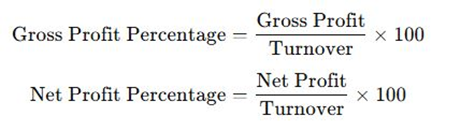
Percentage of Profit to Turnover
JOIN DTW COMMUNITY
Join DTW Tutorials Groups on Facebook, Telegram and WhatsApp Group for Instant Academic Updates Across Nigerian;
WhatsApp Channel – https://whatsapp.com/channel/0029VaAWvTmDDmFT9o25dV3u
Telegram Channel – https://t.me/dtwtutorials1
Facebook Group – https://web.facebook.com/groups/dtwtutorialsgroup/
DTW EDUCATIONAL SERVICES
Go to our website – https://www.dtwedustore.com to purchase your WAEC NECO GCE NABTEB Results Checker Scratch Cards, Text Books, E-Books, Educational Materials etc
Contact us on WhatsApp; https://wa.me/+2348038732879
You can depend on DTW Tutorials to deliver on all your Educational Needs!!
Contact Us today!
– JAMB WAEC BECE NCEE Online Classes both group & 1on1 private classes
– DTW JAMB WAEC BECE NCEE Digital EXAM CBT Past Questions App
– WAEC / NECO / NABTEB Results Checker Cards
– WAEC / NECO / WAEC GCE Original Certificates Processing
– BIRTH CERTIFICATE AND LOCAL GOVT CERTIFICATE PROCESSING
– WAEC / NECO / WAEC GCE Exam Number Retrieval
– WAEC GCE & NECO GCE Registration
– JAMB Form E-pin
– JAMB Profile Code Retrieval
– JAMB Original Results Printing
– JAMB Admission Letter Printing
– JAMB Portal e-facility login access Recovery in the case of Email address & password problems
– Post UTME Registration
We are provide authentic exceptional services!!
DTW Tutorials Study Resource Links;
- The Best JAMB CBT Practice APP By DTW Tutorials – https://dtwtutorials.com/dtw-tutorials-jamb-cbt-app-download-the-best-jamb-cbt-app/
- DTW Online JAMB 2026 Classes, Your Ultimate Path to JAMB 2026 Success! The Best JAMB Online Lessons! – https://dtwtutorials.com/dtw-online-jamb-waec-tutorials-your-ultimate-path-to-jamb-success/
- JAMB 2025 Syllabus Download – https://dtwtutorials.com/jamb-2025-syllabus-free-download/
- 30 Days JAMB Syllabus Challenge Timetable – https://dtwtutorials.com/jamb-2025-syllabus-in-30-days-timetable-challenge-by-dtw-tutorials-cover-your-jamb-syllabus-in-30-days-challenge/
- JAMB Recommended Textbooks for All Subjects – https://dtwtutorials.com/jamb-2025-recommended-text-books-for-all-subjects/
- The Lekki Headmaster JAMB 2025 Novel (Summary, Questions And Answers – PDF Download) – https://dtwtutorials.com/the-lekki-headmaster-jamb-2025-novel-summary-questions-and-answers-pdf-download/
- WAEC WASSCE 2025 Syllabus – https://dtwtutorials.com/wassce-waec-2025-syllabus-free-download/
- 135 PHYSICS FORMULA SHEET BY DTW TUTORIALS – https://dtwtutorials.com/135-physics-formula-sheet-by-dtw-tutorials/



No Comments